A Note for Men: Strategies to Defuse the Female Anger Bomb. (Women, this is also for you. I feel you. I’ve been there.)
In the past week, I had three separate, entirely unprovoked, conversations with men about the same thing: the anger of women, and what on earth to do about it.
Two were patients. One is a friend.
The first patient described a method of strategic retreat. When his partner's anger felt unbearable, he would book travel, leave the house, and inform her he'd be back when she was ready to treat him more nicely. He said this with the exhausted pragmatism of a man who cares deeply about his wife, admits his own imperfections, and feels he has tried everything else he can think of.
The second patient had gone the opposite direction: full engagement. He fights back, defends himself, argues until they're both depleted and retreating to separate rooms to cool down. He also admits his faults, acknowledges his inadequate strategy, and looks tired in a way that sleep isn't going to fix.
And then there was my friend. His situation was different. His partnership is actually fine. His struggle was more existential. As he moves through the world, he has become acutely aware of a collective female anger that he doesn't know how to navigate. Does he hold the door open for a woman, or does that make her feel patronized? Does he make eye contact with the young barista and smile when he says thank you, or does that feel threatening?
In his effort to be respectful and inoffensive, he had, by his own admission, devolved into a spiral of awkwardness so advanced that he could feel it making women more uncomfortable. He knew it. He couldn't stop it. He was, in his words, trying so hard not to be creepy that he had become, in fact, slightly creepy. He was talking to his therapist about it.
We laughed. But I could hear the genuine struggle underneath it.
A necessary distinction
This piece is written for men who are genuinely trying. Men who are paying attention, who feel the weight of the relational dynamic, who want to have a better relationship. It is not written for men who are actually behaving badly — who are controlling, dismissive, cruel, or abusive. Those men are not the target of female anger. They are the source of it. The distinction matters enormously, and I don't want to conflate the two. If you are in an abusive relationship - regardless of gender - please seek appropriate support. This article is not for that situation.
This piece is also written for the men who are checked out emotionally or who are actively shutting down. Maybe you’re not behaving badly, but you may also not be leaning in to the issue because it’s frightening, triggering, or you don’t know what to do. Let me offer some strategies to help you lean in because, if you don’t, you’ll know all too well what resentment feels like before it explodes into anger. This is a well-intentioned invitation to, please, lean in.
The anger is real. And it's bigger than you.
Let me say something that I think men need to hear from a woman who is not angry at them:
Deep female anger is not unjustified. It is just, very often, misplaced. It is also, almost always, a secondary emotion. Hear me out:
The anger we're describing is huge. I'm not just talking about "hey, you said you'd be home at 7 and it's 8 now" kind of anger. That kind of anger is straightforward, valid frustration. I'm talking about the existential rage that is so deep women themselves have a hard time naming its source. It's bigger than you and your relationship. It is ancestral. Generational. Ancient. Collective and personal all at once. Many women are carrying anger about a litany of violations that may predate their current relationship by years, decades, or even lifetimes, if you believe in that sort of thing. Anger inherited from mothers and grandmothers, anger absorbed from a culture that has undervalued, dismissed, and sometimes harmed women for a very long time. And this anger is as big as it is because the emotions underneath it are even bigger: grief, shame, and powerlessness.
Anger is a self-protective, proactive way to address the less conscious, even bigger emotions. That anger is looking for somewhere to land. And the closest, safest target — the man who is right there — often becomes the recipient of something much larger than anything he actually did.
This is not an excuse. It is an explanation. And understanding it is the first step to not letting your relationship or yourselves be destroyed by it.
Here is the spiral as I see it, clinically and personally:
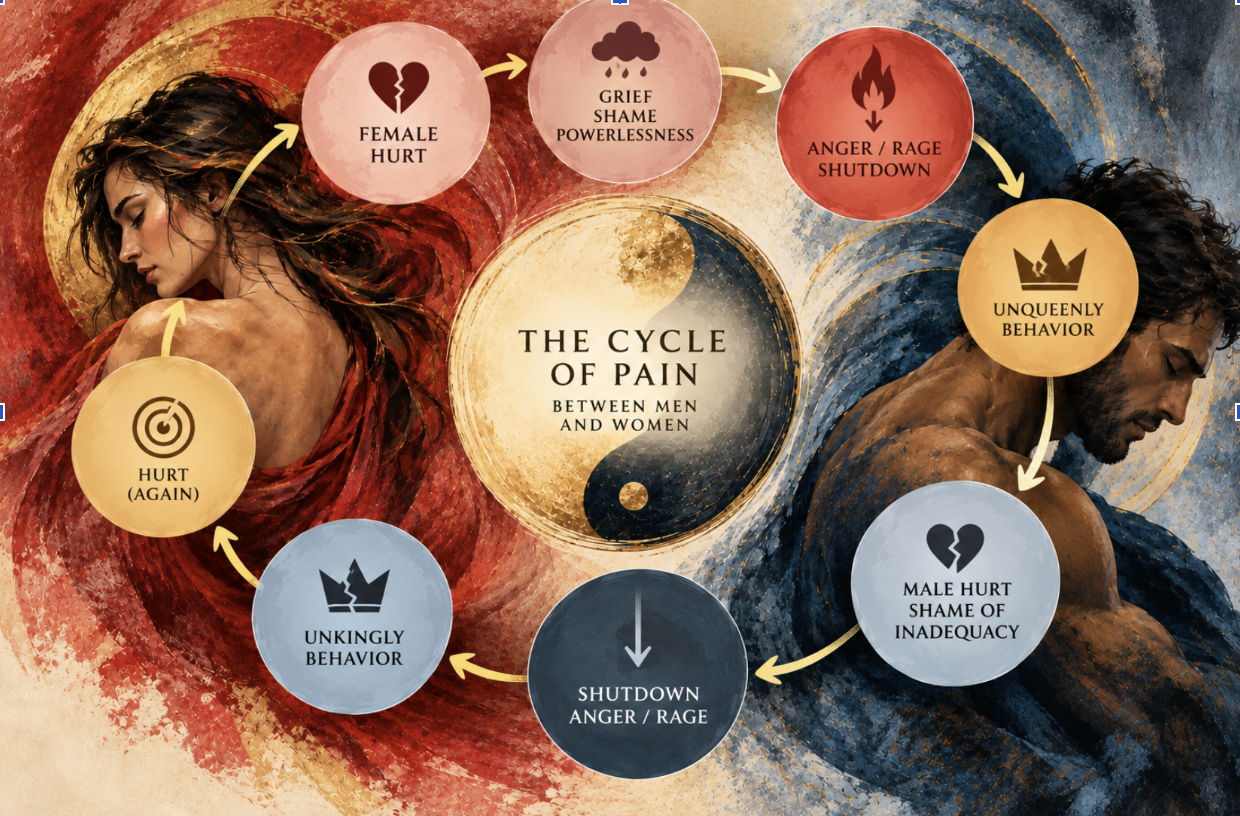
And around it goes.
Anger is almost never the root. Anger is what deep grief, shame, and powerlessness look like when they have nowhere safe to go. If you can help her, and yourself, find the grief underneath the anger, you are both likely to make profound progress. Gabor Maté has written beautifully about how we tend to choose partners who activate our core wounds. Which means the person most capable of enraging her is also, potentially, the person most capable of helping her heal. That's a lot of power. Be careful with it. And yes, it goes both ways.
The impossible bind
Men find themselves in a bind: do something and risk doing the wrong thing, do nothing and invoke the ire of their partner for inaction. It's a no-win situation that exacerbates their own shutdown and frustration.
And these days, men are largely silenced about it. The men who are genuinely trying to be respectful are not saying out loud "hey! this doesn't feel good. I have something to say too." Because they risk some version of (thought, felt, or said out loud): "Women have been mistreated for millennia! Now you know how it feels, you [expletive]." Full stop. Conversation over.
I understand that response. I really do. And I'm not dismissing it.
But I'm also going to say what a lot of people aren't saying: that response, however historically justified, is not helping anyone. It doesn't heal the wound. It just finds a new place to put it. Silencing good men does everyone a disservice.
I want to say clearly: patriarchy is just as bad for men as it is for women. It has asked men to suppress, perform, dominate, compete, and not admit weakness. The cost of that has been enormous. Historical mistreatment of women is bad for men too. Men need healthy women. Women need healthy men.
But here's the problem with abstract systems: they don't make satisfying targets. "The patriarchy” who mistreated your ancestors is not standing in your kitchen at 7pm on a Tuesday having neglected to take the garbage out. Again. The safer, physically present man who is right there, however, is.
Meeting my own rage.
My own rage surprised me. I didn't know it was there. Anger and resentment, yes, I had been working on that in therapy, with progress, and I don't think anyone would have called me an angry person including my husband at the time. My rage made itself known gradually. I first felt it when I was doing my Qi Gong practice and my awareness was deep within my body. It was around my left ovary — a spot where I didn't like to be touched for reasons I had never fully understood.
One night, my husband suggested a night of intimacy. I felt the ovary ache and I contracted away from him. "I think I need to feel this," I told him, and explained as best I could what I didn't fully understand myself. "I think it's rage, and I don't think it's about you."
To his tremendous credit, he gave me one of the greatest gifts of our marriage that night: "I can hold space for you while you feel that."
I'm proud of both of us: me, for allowing the intensity of that feeling to move through me. It was awful and terrifying. Him, for holding the safe space even when it was deeply uncomfortable and even painful for him.
I RAGED. He held me.
I invited him into it, he accepted. He created a container of safety and non-judgment. My deep rage became something we tackled together, as a team. That changed everything.
What surprised me was not only the intensity of my rage but also what was behind it. As it moved, I felt deep shame, disgust, and profound grief. I cried some of the deepest tears I've ever cried. I also had images flash through my mind of experiences that I do not recall having in this lifetime: rape, sexual violence, profound violation. Yes, I’ve had my own experiences of violation, but these particular images were not my personal experiences and somehow I was carrying them, connected to them.
In his book The Power of Now, Eckhart Tolle describes "the collective female pain body." When I tapped into this and saw how deep it was, I realized I needed help. We, as women, need help. This is when I found Womb Awakening and why I now teach it in women’s retreats. Suppressed emotions often present as pelvic pain, reproductive symptoms, or low libido. This is true for men and women.
The experience I describe here was not a "one and done" release of rage. It was a start and a profound turning point. I have made immense progress since that time toward a deep sense of healing and forgiveness: for men, for women, and most of all for myself. I have reclaimed a sense of innocence while also reclaiming the part of me that is joyfully uninhibited. Standing in both and having a profound, unshakeable knowing that they are both real and embodied within me is a gift I would like more people to experience.
What to actually do
These are not magic fixes. They are starting points. Offered with genuine respect for how hard this is.
Move the anger before you try to talk through it.
Anger is energy. It is kinetic and it needs to move. If it doesn't move physically, it will likely move verbally or else it will stagnate and present as physical symptoms. In Traditional Chinese Medicine theory, anger lives in the liver meridian and is thought to be released through physical catharsis: Exercise. Punch pillows. Dance around your living room like a crazy person (music suggestions below). Go to a kickboxing class or grab a racquetball racket and figure out where they put the light switches in those courts. A rage cage (yes, these exist, and yes, they are enormously satisfying) is an amazing outlet. If the relationship is in a safe and connected place, sex — like actually good sex that allows the woman to surrender into pleasure — can be an enormous release. If that kind of intimacy feels out of reach right now, you're not alone, most couples are not having the physical intimacy they deeply desire. (See the resources below).
Get curious about the feelings that existed before you. But first — manage yourself.
Step 1: Manage your own anger response.
Before you can help defuse anyone else's anger, you need to have some mastery over your own. If you don't have that yet, make it your priority. Therapy. Aggressive exercise. A martial arts class. Whatever it takes to develop the capacity to stay regulated. This is not easy. If you feel angry in response, that may be valid, but not helpful.
A word of recognition specifically for the men who feel the capacity for violent eruptions within themselves and consistently manage not to act on it: that is an under-appreciated act of self-mastery, and it deserves to be named. It is not nothing. Healthy masculinity is not about never feeling the capacity for violence. It is about having mastery over that feeling so that you do not hurt people. Give yourself credit and cultivate this even further. Make sure you are not suppressing your own anger and that you move it through physical catharsis away from your partner. Exercise is a great way to do this. Move it before you try to have a productive conversation.
To be clear: the expectation of emotional self-regulation is not a gendered one. Everyone is equally responsible for doing their own work, and a relationship in which one person is expected to manage themselves while the other is not held to the same standard is not a partnership. It is a dynamic that will eventually collapse under its own weight and no one should have to walk on eggshells through their whole relationship. Anger is a normal, frightening, and extremely difficult emotion to handle. The goal is that we are able to feel it, process it, not suppress it, and support each other through it as kindly as possible.
Step 2: De-escalate in the moment.
When the anger flares, your job is not to fix it right then. Your job is to keep the situation from getting worse and try to steer away from your own explosion or shut down. Aim for: "I love you, I am NOT ABANDONING YOU. I'm not abandoning this topic, you or your anger. But if we keep going right now, I'm either going to shut down or get reactive and neither response will be helpful to you, to me, or to us."
Circle back to step one: manage and move the anger safely. Take a walk. Take deep breaths. Then, in a calmer moment, decide on your rules of engagement for when things escalate. Something like: "When you express anger like that, I'm not going to explode or shut down. I'm going to de-escalate and step away. But I want you to know: I am not abandoning you or this topic. I love you. I commit to returning to this with you when we're both calmer." And then PICK A TIME to come back to the topic. Don’t just say that and let it hang. Pick an actual time, put it in your calendars, and circle back to do the hard work.
The goal is to make de-escalation feel like an act of love - not abandonment, not avoidance, not dismissal. If she has abandonment wounds (and many women do), your exit needs to come with a clear, loving promise to return.
One more thing: don't assume it's just hormones. Hormones are real and powerful — but they affect a woman's capacity to cope with pain while not being the underlying source of it. No amount of estrogen patches or progesterone capsules are going to dissolve grief or rage that hasn't been felt yet. Those feelings were there before the hormonal shift made them harder to contain.
Step 3: In a calmer moment — seek to understand.
When the temperature has dropped, come back. Re-affirm your love. Confirm the rules of engagement. For hard discussions, consider talking while taking a walk - it helps move the energy, reduces the intensity by standing side by side instead of face to face, and usually puts you in more neutral territory. And then, if she's willing to open, get curious.
Some possible questions to explore together or in couples therapy:
"Have I mistreated you? If so, how — and how can we move forward together?"
Then, Listen. Keep your pride in check. Clarify if she wants you to problem solve in this conversation or just listen. Are you fixing something or just holding space for her to vent? Clarifying that can make a big difference because it lets you know how to hold space for the conversation.
Some questions for her to explore on her own or in individual therapy (but the answers may help you understand the size of the iceberg below the surface, and understanding helps with compassion):
"Has she felt mistreated by men before your relationship? Has she watched the women closest to her (her mother, sister, friends) be treated in ways that left a mark? In what ways might that history be showing up in how safe she feels with you, the man in front of her now?"
Remember, you may have genuinely done something that hurt her, and that's yours to own. But there is almost always a much larger part of the iceberg below the surface - for both of you. A reminder to be gentle with each other.
Ask for specifics. Give her a container.
When the moment is right, try this:
"Can you name two things you're resentful about? And for each one, as someone who genuinely wants to help, can you give me one concrete action I can take soon that would make it better?"
Two things. Not twenty. Specificity and simplicity are kind to everyone.
Then, and this part matters, ask if there will be a time when she'd be willing to hear your own list of two things without getting defensive. If she says no, suggest smashing something (or multiple things at the rage cage) first. Plan the date yourself - be proactive. Then ask again. Get her permission before you have that conversation. Establish the parameters. A conversation that starts with consent goes very differently than one that ambushes.
Validate without getting stuck.
"Yes, that sounds genuinely awful. Is there more you want to say? How can we move forward together in a way that feels safe and honoring for both of us?"
Notice: you are not agreeing that you are the villain. You are acknowledging her pain and moving toward something generative. Those are different things.
Keep holding the door.
To my friend and his barista dilemma: hold the door. Make eye contact. Say thank you and mean it. Don't stop being kind and chivalrous because it isn't always received the way you'd like. The alternative - the anxious, avoidant, overthinking spiral - helps no one.
The world needs men who are grounded enough to offer warmth without needing it to be perfectly received. That steadiness, more than anything, is what creates safety. And safety, for both of you, is what makes everything else possible.
A prayer worth reading
Marianne Williamson wrote a prayer of amendment between men and women that I find genuinely moving. I'd encourage any man (or woman) navigating these dynamics to sit with it — and consider reading your half to your partner and receiving the other half. It's deeply powerful and changed my own life.
A closing thought
The men I spoke with last week are not the problem. They are, if anything, evidence of the solution: men who are paying attention, who feel the weight of the relational landscape, who are trying to figure out how to show up better.
The anger between men and women right now is real. And it is, I believe, a symptom of something that can be healed, or at least greatly improved — not by one side winning, but by both sides doing their own inner work and then turning toward each other with something more useful than a scorecard.
A healed feminine helps rebirth the masculine. A healed masculine helps spark new life in the feminine.
We are interdependent. We need each other. Even when, especially when, it doesn't feel that way.
Dr. Laura Chan is a Naturopathic Doctor, Acupuncturist, Qi Gong instructor, & burgeoning Coach, working at the intersection of integrative medicine and energy cultivation. She works with both men and women on vitality, energetic & hormonal health, relationships, sexuality, and is fascinated by energetic self-mastery. She is a champion of both men and women, healthy masculinity and healthy femininity. Learn more about her upcoming women’s retreat here.
Resources
Favorite angry songs (that I can actually dance to):
Miniamba by Future Prophesies
Baptism by Crystal Castles
Survival by Amirya
Float on by Modest Mouse
These won’t be to everyone's taste. What works for you? Please share with me!
Favorite Healthy Sexuality & Intimacy guides:
David Deida (Books: “The Way of the Superior Man” and “The Enlightened Sex Manual” to start… )
Sheri Winston (I especially like her book “Women’s Anatomy of Arousal”)
Margot Anand (Book: “The Art of Sexual Ecstasy”)
Kim Anami (online workshops are bold, a little crass & shamelessly exhibitionist. Not everyone’s style, but she is trauma informed and 100% knows what she’s talking about regarding sexuality. Her work is transformative for men, women, & couples)