A man in his mid-fifties came in for an acupuncture appointment recently. He's in the second year of a sabbatical from a high-stress career, and he can't stop smiling as he describes how happy he is to be on a healing path.
Within minutes of the needles going in, I could tell he was starting to feel a lot of emotions move. It's part of how acupuncture works. In Traditional Chinese Medicine, emotions are held in the meridians, and when they get jammed up, they can show up as symptoms, pain, or disease. I could see him clenching his jaw, and I heard his breath become jagged and his chest shook. His hands squeezed in an effort to keep himself from emoting, determined not to cry in front of a woman he had just met. As I kept working I said, "By the way, it's totally normal if you feel a lot of emotions. That's part of the process. Feel free to let them move. I see it all the time." His breathing relaxed. A tear dripped down his cheek. I stayed silent and kept my energy neutral. This did not faze me.
Two minutes later, as I was preparing to leave the room so he could rest, he said: "Dr. Laura? Can you please wipe the tears off my face? I don't think I can move my arms because of the needles."
I told him I'd be honored, and I did. When I came back into the room 15 minutes later, he told me he had never felt so relaxed.
I've been reflecting on that moment because of what it took: a stranger, a treatment table, and a literal inability to move his arms before this man could allow himself to cry. A recipe that most men don't get to experience.
The gaslight
Patriarchy is a social system in which men hold primary power, including political leadership, moral authority, social privilege, and control over property, while women and marginalized groups are largely excluded or subordinated. Gaslighting is a form of psychological manipulation in which a person distorts facts or rewrites history until the other person begins to doubt their own memory, perception, and judgment.
Yes, patriarchy has harmed women and minorities. That is well documented, and I have no interest in minimizing it. But I want to talk about something we discuss far less often, which is what it does to men.
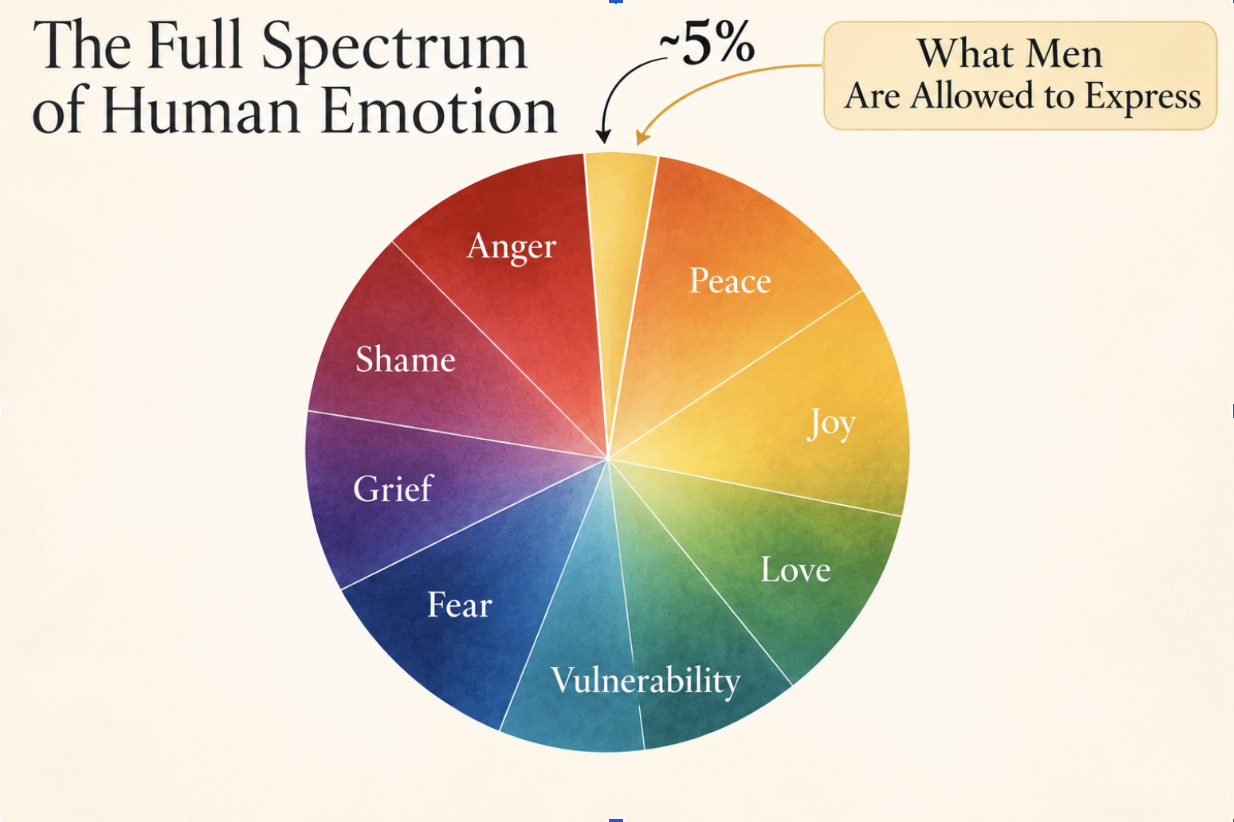
We tell men that patriarchy hands them power, status, and privilege. And some men do hold those things. But for the individual man sitting in my office, quietly carrying decades of unprocessed emotions including grief, rage, shame, inadequacy, and loneliness, that message is a form of gaslighting. It tells him his situation must be a good one, so he has no right to complain. Meanwhile, the same system teaches him that asking for help or showing vulnerability is weakness, so he can't ask anyway. Override your emotions. Perform. Provide. Be stoic, and be grateful. Both rules arrive in the same package, and together they leave a man with no outlet to process normal human suffering.
Men are allowed to sit shoulder to shoulder staring at a TV with sports on, drink in hand. Eye contact, emotional vulnerability, or discussions outside of sports, work, or finance can feel like dangerous territory. They might seem weak, or be called gay — a deeply unfair insult to gay men, many of whom have worked to overcome masculine conditioning in order to be more authentic.
For some reason, this masculine conditioning is stronger in North American men than in some other parts of the world. I remember traveling in India and seeing straight men showing physical and emotional affection to each other. It's culturally acceptable there in a way it's not allowed in other parts of the world, and in a way that deprives men of connection that they crave and need.
I see the cost of this emotional repression in men often in my office. Not long ago, a 65-year-old engineer came to me for blood pressure and ankle pain, nudged in by his wife like so many of my male patients. He was skeptical of acupuncture, and words like "Qi" and "meridians" felt a long way from his world, but he was willing to try. At each visit I asked about his emotional state, because in my work emotions help explain what is happening in the body. One day I asked again and he paused for a long time. Then he said, "I'm 65. No one in my life has ever asked about my emotional state."
I was changing the table sheets for my next patient, but I sat back down. This needed presence. "How does that make you feel?" I asked.
"Sad."
It makes me sad too, I told him.
Where "man up" comes from
I don't think most of us set out to do this to men. I certainly didn't. But I have two young sons with big feelings, and one afternoon, in the middle of a meltdown over something small (to me), two words flashed into my mind: man up. Thankfully, I caught myself before I said it out loud.
Afterward, I was somewhat appalled with myself, and I wondered where that reflex came from. I thought for a while and remembered hearing it from male relatives and from friends in high school and college. It's embedded in our culture deeply enough that it became a reflex I almost acted on. "Man up" almost always means the same thing: stop expressing yourself.
From a TCM perspective, that is the beginning of pathology. Tears move grief. Shaking or crying releases fear. Physical exertion moves anger. When we tell a boy to swallow all of that, the emotion doesn't disappear. It stagnates, and stagnation eventually becomes pain or illness. The seed may take decades to sprout, but it is planted early, and often by people who love him. I am determined to work on my cultural programming so that I do not perpetuate this pattern with my own sons. It's a start, but I'm concerned about the culture they will face outside our home.
The author and theologian Matthew Fox has written thoughtfully about why men keep their inner lives hidden. He points out that men are rarely rewarded, and often mocked, for openly expressing joy, sensitivity, or pain. Many carry wounds they would rather forget than admit. Many never received a rite of passage that marked the move from boyhood to manhood, and many grew up with fathers whose communication was cold or nonexistent. (For his list of reasons as to why men keep their inner lives hidden, click here)
I informally asked several of my male patients this past year whether they had male role models. All of them said no.
Fox also names something that stopped me when I read it: that some men, in an attempt to respect the women's movement, feel compelled to silence themselves and hide any "unacceptable" maleness. That one is the thread I pulled in my article about female anger, where I wrote about men who are genuinely trying to be respectful and have concluded that the safest course is to say nothing at all.
And it isn't only grief and fear that go underground. Some of the men I know are deeply sensitive, emotional, and empathic, and some are even clairvoyant, though they don’t recognize it in themselves. They allow me to see this in them in my office - I’m usually the one pointing it out - but they feel unable to share it with most other people. I suspect they fear it will cost them respect, or their place among other men. Think of how much intuition, beauty, and wisdom we lose when a man learns to hide the most tender and perceptive parts of himself.
When men aren't allowed to feel their feelings, they numb them: alcohol, drugs, pornography, TV or social media scrolling, workaholism (the socially acceptable addiction). When overused, these "outlets" exacerbate shame and shutdown. The men suffer and the people in their lives pay the price as well.
Why this is bad for women too
It would be easy to stop at "men are suffering," but it's an incomplete story. When a man can't feel, he can't be fully met, and the people who love him live with the consequences. His partner gets the silence, or the shutdown, or the explosion that arrives when a lifetime of swallowed feelings finally escapes sideways. His sons learn to man up. And the grief and anger that so many women carry, often old, inherited, and far bigger than any one relationship, are left looking for a partner who has no idea how to meet their emotions, having not met his own. Patriarchy harms women and marginalized groups directly, and it harms them again through the men in their lives who were never taught or allowed to feel.
Our culture's response to patriarchy can teach women that men are the problem, and patriarchy itself teaches men that their pain isn't valid. Neither message is fair, and neither helps us move forward.
I've also written about our own shadow side as women, and how easily we can slide into blaming men for everything while missing the deep personal work we as women have in front of us. We can acknowledge a long history of harm to women and still recognize that men are hurting, that stoicism has been enforced on them for generations, and that this has a cost to everyone.
There is one more piece, and it's for all of us, women included. Patriarchy doesn't only silence men's emotions. It devalues the feminine itself: stillness, rest, quiet, softness, receptivity, intuition, feeling, pleasure, ease. We reward performance and action, and we treat slowing down as laziness. Women have been pressured to adopt that same relentless doing in order to be taken seriously, and men have been taught to cut off the soft parts of themselves entirely. But every one of us carries both archetypes, the feminine and the masculine. We need both, in men and in women. So part of the way out is to find reverence for the feminine again, in our culture and in ourselves: to value rest as much as productivity, quiet as much as noise, softness as a form of power, pleasure as much as performance, and stillness as much as striving.
The way out, I believe, is not easy, but not impossible. We must start talking about it.
I think about my two boys and about that man on my table with tears running down his face. I want them to grow up in a world where a man doesn't need acupuncture needles and a near-stranger to give himself permission to cry. We can build that world. It starts with the questions we ask, the reflexes we catch, and the stories we're willing to say out loud.
Strong, grateful, and silent was never the whole of a man. Let's tell them they're allowed to be human.
Dr. Laura Ives Chan is a Naturopathic Doctor, Acupuncturist, Qi Gong instructor & Men’s Coach, working at the intersection of integrative medicine and energy cultivation. She works with both men and women on vitality, energetic & hormonal health, relationships, emotional wellbeing, sexuality, and the conscious cultivation of life force energy. More at drlauraives.com